In short, the difference between OEM, ODM and CM comes down to who designs the product, who manufactures it and who owns the design. An ODM offers products it has already designed, an OEM makes a product specifically for your device, and a CM produces exactly what your documentation specifies. In display projects at Riverdi, this usually means choosing between an off-the-shelf display, semi-custom and a custom one.
If you are sourcing a display for a new device, you may sooner or later come across these three acronyms. Interestingly, the engineers we work with at Riverdi rarely use them. They talk about whether an off-the-shelf display will do or whether they need a custom one, how soon they can have a prototype, and whether it will work with their microcontroller. The acronyms still matter, because behind them sits a practical question: who designs the product, who builds it, and who owns the result. Below we go through the three models as they look in embedded display projects, including where Riverdi fits.
OEM, ODM and CM – quick comparison
Who designs, who manufactures, who owns the IP
In the textbook definitions, an OEM or a CM builds to your design, so you usually own the IP, while an ODM designs the product itself and keeps the IP. Custom display projects sit somewhere in between. The display is made for your device, which is why it is commonly called OEM work, but the design effort, and often the IP, stays with the display manufacturer.
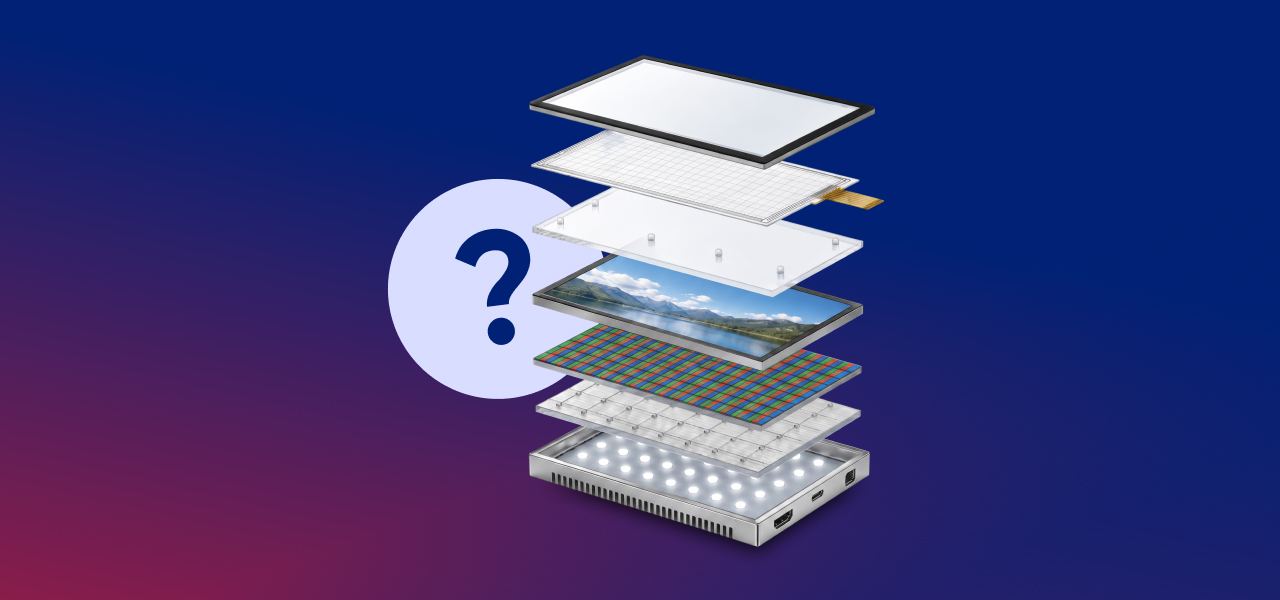
With displays, it also helps to look at the layers, because each layer has a different answer.
The LCD panel. LCD panel production is concentrated in Asia. This layer is largely standardized, so most of what makes one display different from another happens in the layers above it.
Touch panel, bonding and firmware. This is where engineering starts. A capacitive touch sensor behaves very differently behind thin cover glass than behind 6 mm vandal-resistant glass on a parcel locker, so the touch controller firmware has to be tuned to the glass, the mounting and the conditions of use. At Riverdi, this work is done in Poland.
The controller board (PCB). This board lets the display communicate with your microcontroller or processor. We design these boards ourselves, and they are assembled in Poland by our local manufacturing partner. The design is Riverdi’s intellectual property, and it is also the layer where the difference between a manufacturer and a reseller is easiest to check.
Comparison table at a glance
| OEM | ODM | CM | |
| What you bring | Your requirements or specifications | A choice of existing product, optionally your branding or minor changes | Complete, production-ready documentation |
| Who designs | The manufacturer, you, or both | The manufacturer | You |
| Who usually owns the design / IP | Traditionally you; in custom display projects often the manufacturer (check the contract) | The manufacturer | You |
| Customization | Full | Limited to the existing design | Exactly as specified |
| Time and upfront cost | Higher | Lowest | Depends on your design’s maturity |
| Best when | No standard product fits your device or conditions | An off-the-shelf product fits your needs | You have a finished design and need production capacity |
In Riverdi’s display projects, the acronyms map onto three terms you will hear far more often. An off-the-shelf, standard display, chosen from a catalog and integrated as it is, follows the ODM model. A semi-custom display is still based on an existing design, adapted to your device with selected changes, so it stays close to ODM as well. A custom display, developed for one customer’s device, is what OEM usually means for us. Pure contract manufacturing is the least common model.
OEM (Original Equipment Manufacturer)
What OEM means in practice
An OEM (Original Equipment Manufacturer) is a company that makes products or components for other businesses, built to their requirements and used in their own products.
At Riverdi, OEM work usually means custom displays. The textbook version assumes the customer arrives with a complete specification: panel, touch, cover glass, interface. In practice, that is uncommon because most device makers don’t have display specialists in-house. They come with a functional requirement instead, and our engineers turn it into a specification and a design. As in most of our projects, our R&D team is involved from the start.
Examples – ultrasound and welding screens
One customer needed an ultrasound screen that could be operated with wet gloves. Another needed a display for welding equipment mounted on the back of a pickup truck in Arizona where it had to withstand temperatures of up to 100°C. In both cases, the customer defined what the display had to do, and our team selected the touch technology, glass and tuning, and designed the controller board, often around the STM32 or NXP platform the customer already uses.
Pros of choosing OEM
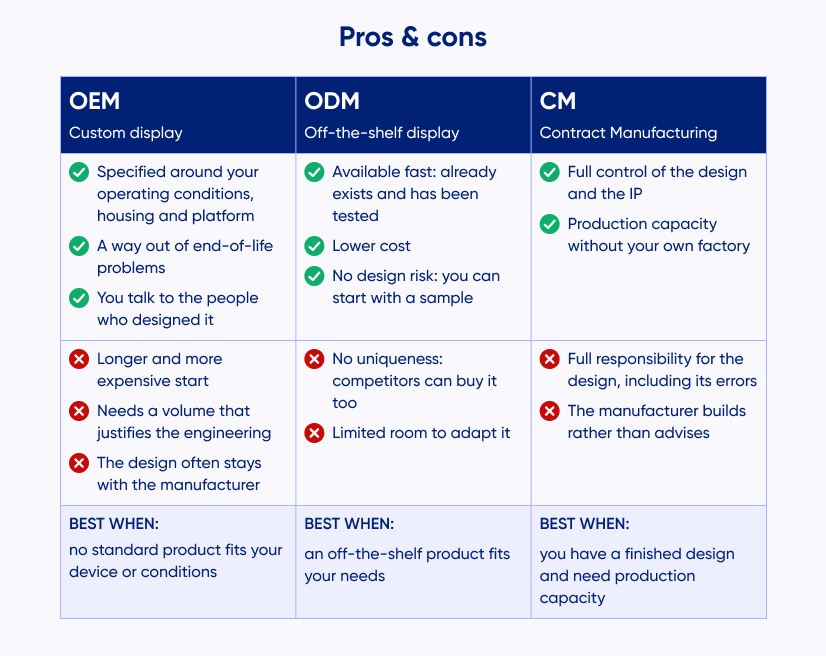
- The display is specified around your actual operating conditions, housing and platform, not around a generic datasheet.
- It offers a way out of an end-of-life problem. When a current supplier discontinues a display without a replacement, we can design an equivalent that fits the existing housing.
- The people who designed the display are the ones you talk to when something needs to be investigated.
Cons of choosing OEM
- The start takes longer and costs more than with an off-the-shelf product: engineering, prototypes and validation come before series production.
- Custom work needs a volume that justifies the engineering effort. For a handful of units, it usually doesn’t.
- Who owns the design depends on who created it and on the contract. In a textbook OEM arrangement it is the customer. In custom display projects, the manufacturer usually does the design work, and at Riverdi, the design remains our intellectual property. You can’t pass the documentation to another supplier and expect an identical product; a new supplier would begin its own development. That is worth knowing up front, and it is one more reason to choose a partner you expect to work with for your product’s full lifecycle.
Customers don’t come to us with a drawing of a display. They come with a problem: a screen that has to work with wet gloves, or survive the sun on a truck in Arizona. Working out how to get there is our job.
— Łukasz Kowalski, Sales and Marketing Director, Riverdi
ODM (Original Design Manufacturer)
What ODM means in practice
An ODM (Original Design Manufacturer) is a company that designs and manufactures products that other companies sell or integrate under their own name. When the product is sold under the buyer’s brand, this is often called white label or private label manufacturing.
At Riverdi, ODM corresponds to off-the-shelf products: displays and embedded modules designed in advance, not for any single customer, and integrated largely as they are.
Example – bare displays vs embedded modules
The simplest case is a bare display, without touch or a controller board. If two suppliers offer the same size, resolution and brightness, the products are close to interchangeable, apart from details such as color tint. This changes as you move up the layers.
An off-the-shelf module with its own controller board is a specific design. If you build your device around one of our STM32 display modules, you can’t replace it one-to-one with another vendor’s board; you would need to adapt your hardware and software. So, even among off-the-shelf products, how replaceable a part is depends on how much engineering is inside it.
Pros of choosing ODM
- Faster availability: the product exists and has already been tested.
- Lower cost because development costs are spread across many customers.
- No design risk. Evaluation can start with a sample instead of a development project.
Cons of choosing ODM
- No uniqueness: the same product is available to your competitors.
- Limited room to adapt it. Once your requirements go beyond small changes, you are in custom display territory.
When a standard display is almost right: semi-custom
At Riverdi a semi-custom display starts from a display already in our portfolio and changes only what your application needs, for example a different cover glass or a modified board. Because the base design is already proven, a semi-custom project is usually faster and less costly than a full custom one. Many customers first test a few standard units in their device. Once they know what needs to change, our engineers help them decide which modifications are worth making.
CM (Contract Manufacturer)
What CM means in practice
A CM (contract manufacturer) produces products entirely to another company’s design and documentation. Responsibility for the design stays with the customer. This model suits companies with strong in-house expertise that mainly need production capacity.
At Riverdi, it is rare. We can do it, but it is not how most of our projects work, largely because customers seldom have display specialists in-house and our engineering is usually why they come to us.
Example – how Apple uses Contract Manufacturing
The best-known example is Apple and Foxconn. Apple’s engineers provide detailed production documentation, and Foxconn builds the iPhone to it. The design decisions stay with Apple.
In our relationship with customers, Riverdi works the other way round: design is the part of the process we want to be responsible for.
Pros of choosing CM
- You keep full control of the design and the IP.
- You get production capacity without building your own factory.
Cons of choosing CM
- You carry full responsibility for the design, including its errors.
- The manufacturer builds rather than advises, so issues rooted in the design, such as poor touch tuning, come back to you.
Simple analogy – coffee mugs explained
OEM, ODM and CM in one example
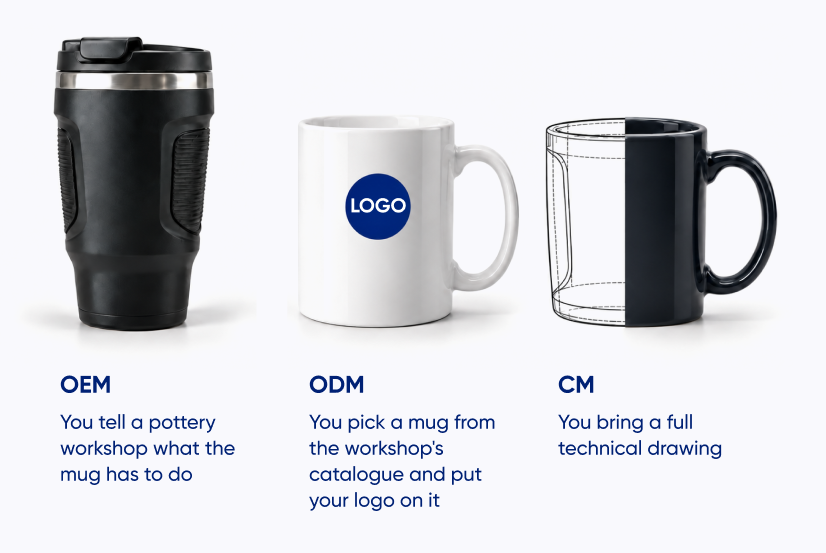
Imagine you are ordering mugs for your company.
- OEM: you tell a pottery workshop what the mug has to do, such as keep coffee warm for a site crew and fit a car cup holder. They develop a mug just for you, drawing on what they know about clay and glaze.
- ODM: you pick a mug from the workshop’s catalog and put your logo on it.
- CM: you bring a full technical drawing, clay and glaze included, and the workshop produces exactly that.
A display is more complex than a mug: it is built in layers, and each layer can follow a different model, as we showed above.
Which model should you choose?
Decision rule of thumb (quick recap)
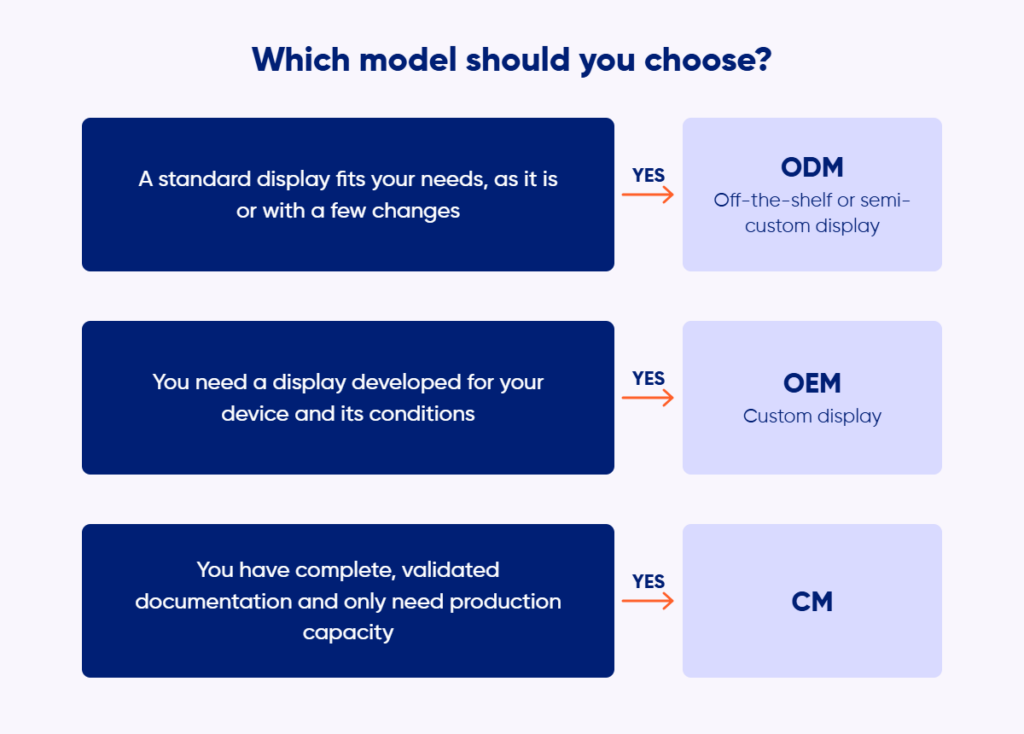
- An off-the-shelf product meets your requirements, and time matters most: ODM.
- You need a display developed for your device and its conditions: OEM (custom display).
- You have complete, validated documentation and only need production capacity: CM.
- A standard display is close to what you need, but not quite: ODM with semi-custom changes.
Choosing based on priorities: uniqueness, speed or existing design
If uniqueness and fit matter most, you need a custom display. If you need a better fit but can’t wait for a full development, a semi-custom display is often the middle ground. If speed matters most, start with off-the-shelf products. If you already have a proven design, contract manufacturing may be enough.
There is one more criterion that general OEM, ODM and CM comparisons don’t cover, because it is specific to embedded projects: the platform. Many embedded engineers choose the microcontroller first, often from an ST or NXP family they already know well, with its tools and their own existing code. Everything around it, the display included, should fit into that setup without extra integration work. For them, the real question is whether a proven display exists for their platform. Riverdi is a member of ST’s Partner Program and appears as a display partner on NXP’s website, which gives you an independent way to check that the combination has been validated.
Why “OEM” can be confusing across industries
Automotive vs consumer electronics definitions
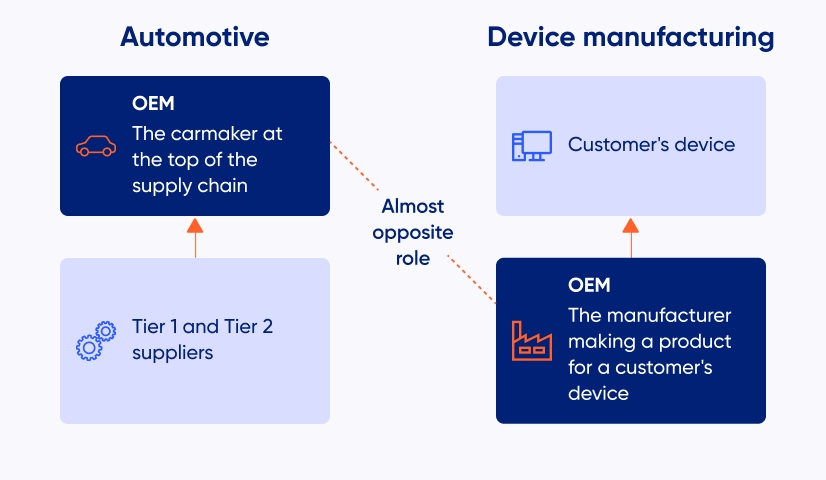
In the automotive industry, the OEM is the carmaker at the top of the supply chain, such as Toyota. Companies that build components to order for it are called Tier 1 and Tier 2 suppliers.
In the electronics sense used in this article, the OEM is the manufacturer making a product for a customer’s device, which is almost the opposite role. Usage varies within electronics too: in the PC industry, for example, the brand owner is often called the OEM.
The display industry adds a few more meanings. “OEM display” can describe a display intended for integration into another company’s device, a custom display made for one device maker, or, in the repair market, an original part as opposed to an aftermarket replacement. If a supplier or colleague uses the term, it is worth asking what they mean before comparing offers.
For most embedded display projects at Riverdi, the choice comes down to two paths: an off-the-shelf display, if a catalog product meets your requirements, or a custom display, if your device, its operating conditions or your platform need something built for them. Contract manufacturing makes sense mainly when you already have a complete, validated design.
Not sure which path fits your device? Tell us what your display has to do, including the conditions, the housing and the platform, and our engineers will tell you whether an off-the-shelf display will do or what a custom one would involve. Talk to our engineers.
DISCOVER OUR
Whitepaper
Achieve the perfect user-display interaction with the right Touch Sensor IC. Ever faced issues with phantom touch events or certification? Boost your R&D like a pro with our Whitepaper!
Go to our product catalog and see how you can save by quality, not on quality.