Table of Contents

Front view of uxTouch and aTouch

Back view of uxTouch and aTouch
aTouch and uxTouch represent two different mechanical integration philosophies. The difference is not related to optical performance, but to how the display is mounted, secured, and sealed within the device enclosure.
Understanding this distinction helps select the right solution already at the enclosure design stage.
aTouch –Traditional mechanically secured integration
aTouch follows a classic module-based mounting concept. The display is installed inside the enclosure and mechanically secured using structural elements such as screws, brackets, spacers, or compression frames.
In this approach:
- The display is inserted into a machined opening in the housing
- Mechanical fixation is required (“screwed-in” integration)
- The enclosure defines the visible front geometry
- Sealing depends entirely on the enclosure design
The enclosure is responsible for:
- Mechanical stability
- Load distribution
- Vibration resistance
- Compression control
- IP protection level
Because aTouch has a traditional rectangular module structure, it must be physically retained within the housing. Any environmental protection (dust, moisture, water ingress) is achieved through gaskets, compression frames, or sealing solutions defined by the customer’s mechanical design.
In short, aTouch relies on the enclosure architecture for fixation and sealing.
uxTouch – Front glass-to-housing mounting
uxTouch is designed for direct front integration through the cover glass. Unlike traditional modules, it does not require front-side mounting holes. The glass surface becomes the visible and structural front interface of the device.
In this concept:
- The display is mounted from the front
- The glass is attached directly to the enclosure surface
- No front mechanical fasteners are required
- A flat, modern front panel design is naturally supported
For fixation and sealing, Riverdi commonly uses 3M 9495LE acrylic adhesive transfer tape as a standard solution.
This adhesive-based mounting:
- Provides both bonding and perimeter sealing
- Eliminates the need for front screws
- Simplifies enclosure machining
- Enables clean, flush front integration
Optional rear support brackets are recommended in applications exposed to high vibration or mechanical stress.
Sealing Philosophy Comparison
The sealing strategy differs fundamentally between the two concepts.
aTouch
- Sealing is defined entirely by the enclosure
- Requires mechanical compression (gasket + frame)
- IP rating depends on structural design
- No predefined adhesive sealing interface
This solution offers high flexibility but requires more mechanical design effort.
uxTouch
- Sealing is integrated into the mounting concept
- Adhesive (e.g., 3M 9495LE) provides perimeter sealing
- Simplifies flat front designs
- Higher IP levels are typically easier to achieve
However, final IP performance always depends on the complete enclosure design, material selection, gasket compression strategy, and environmental requirements defined by the customer.
Key Integration Differences
| Area | aTouch | uxTouch |
| Mounting method | Mechanically secured inside enclosure | Front glass-to-housing mounting |
| Front design | Defined by enclosure | Defined by cover glass |
| Front fasteners | Required | Not required |
| Sealing method | Gasket + mechanical compression | Adhesive perimeter sealing |
| Mechanical complexity | Higher | Lower |
| IP implementation | Fully enclosure-dependent | Simplified, but still enclosure-dependent |
When to choose each solution
Choose aTouch if:
- Your design already includes a mechanical mounting frame
- The display is part of a larger structural assembly
- Sealing is controlled by compression and hardware
- You prefer a traditional “industrial module” integration
- You want to have easy access to the display backside
Choose uxTouch if:
- You are designing a flat, modern front panel
- You want to eliminate front screws
- You prefer adhesive-based integration
- You aim to simplify enclosure machining and sealing design
- Need higher IP rating
- You don’t need to dismount the display later on
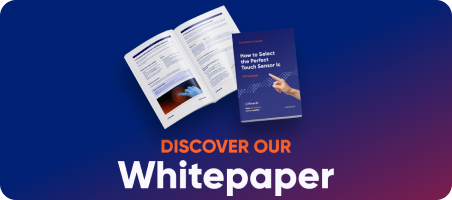
DISCOVER OUR
Whitepaper
Achieve the perfect user-display interaction with the right Touch Sensor IC. Ever faced issues with phantom touch events or certification? Boost your R&D like a pro with our Whitepaper!
Go to our product catalog and see how you can save by quality, not on quality.