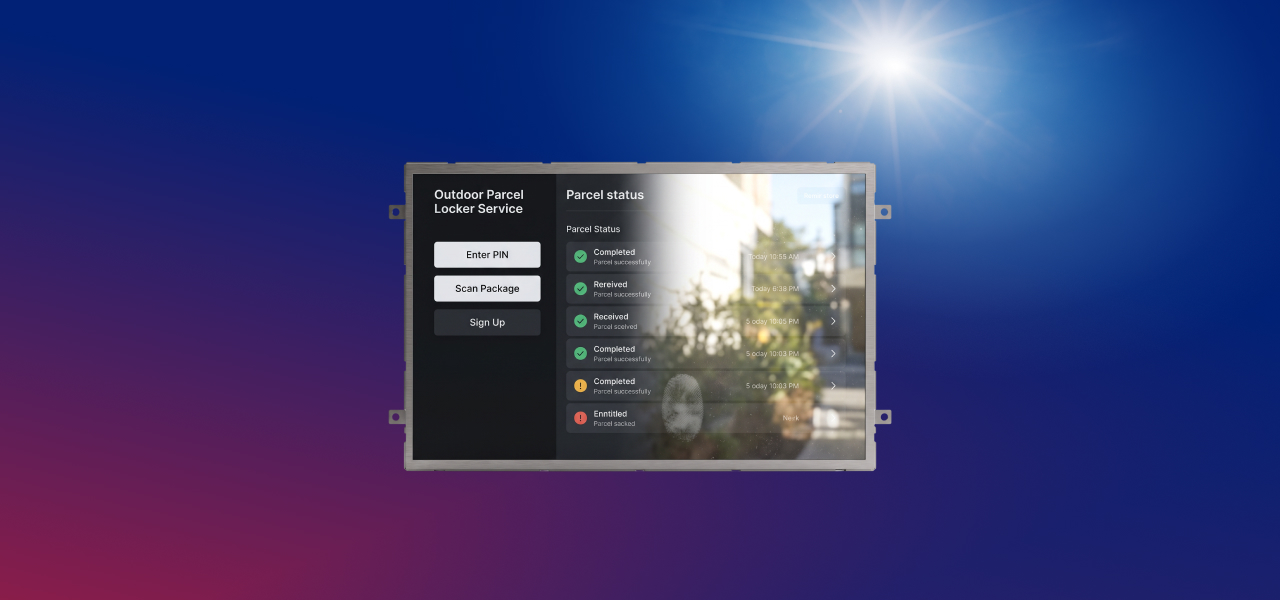
A monitor is sunlight readable when its optical stack preserves enough contrast under strong ambient light. The result depends on panel luminance and on how much light is reflected by the touch sensor, bonding interfaces, cover glass and surface treatment.
Quick answer
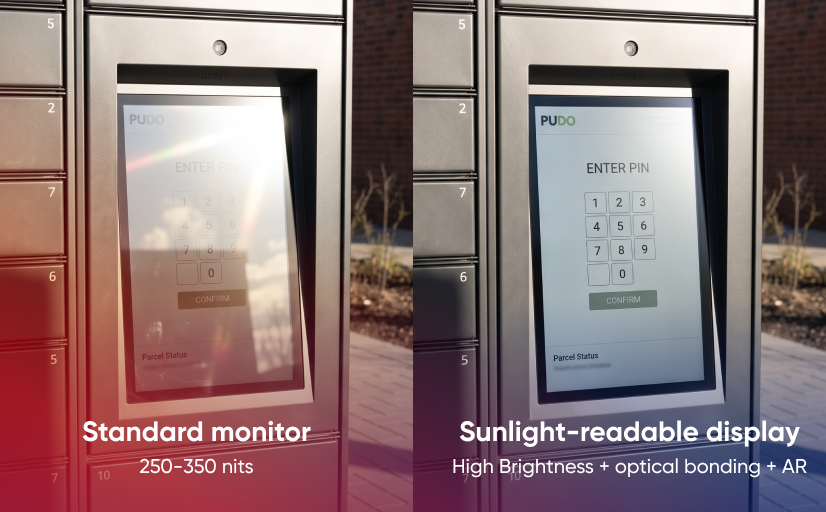
Most sunlight-readable monitors use 1,000 to 4,000+ nits together with optical bonding or surface treatments that keep reflection low. Standard indoor monitors are usually rated at 200 to 350 nits.
Ambient-light reflections raise both white and black luminance, reducing the contrast visible to the user.
| Display type | Typical brightness |
| Standard indoor monitor | 200–350 nits |
| Sunlight-readable monitor | 1,000–4,000+ nits |
Brightness is specified in nits, equivalent to cd/m².
Brightness requirements by environment
| Environment | Recommended brightness | Example applications |
| Bright indoor area | 500–1,000 nits | Factory HMI, medical equipment, indoor kiosk near a window |
| Partial sun or covered outdoor location | 800–1,000 nits | EV charger under a canopy, ticket machine, marine control panel |
| Full sun | 1,000–4,000+ nits with low-reflection optics | Outdoor terminal, transport display, construction equipment, window-facing monitor |
Treat these ranges as initial targets.
A well-bonded 1,000-nit module may remain readable outdoors, while a much brighter panel can perform poorly behind reflective glass or several air gaps.
Effective Contrast Ratio (ECR) should be checked on the assembled module because the touch sensor, cover glass and air gaps change the contrast available under ambient light.
Core technologies behind sunlight readability
- High-brightness LED backlighting – a higher-output backlight sends more luminance through the LCD stack. The trade-off is greater power consumption and more heat inside the enclosure.
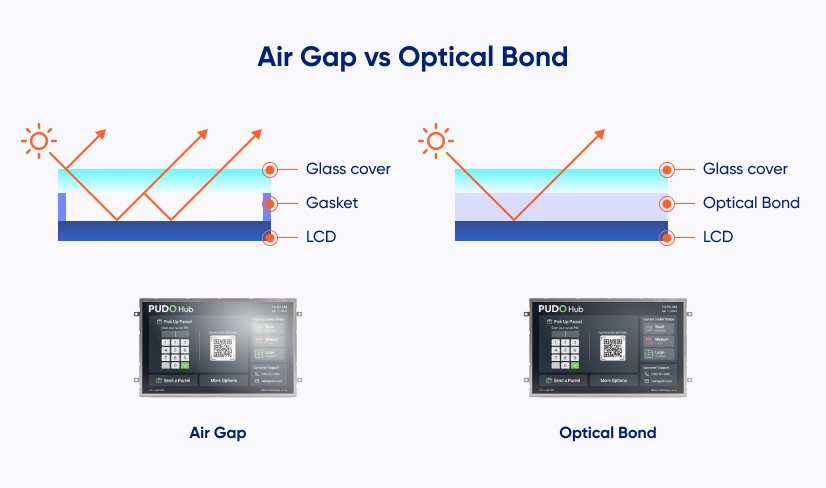
- Optical bonding – optically clear material replaces the air gap between the LCD, touch panel and cover glass. This can reduce reflection from that internal interface by about 99%, although the outer glass surface still remains reflective.
- Anti-reflective coating – AR layers reduce reflection at the external glass surface. Depending on the coating, typical glass reflection of approximately 4–5% can fall to around 1–2.5%.
- Anti-glare coating – AG treatment spreads reflected light instead of producing a clear mirror image. It reduces concentrated glare, but surface haze can affect apparent contrast and fine-detail sharpness.
- Transflective technology – a transflective LCD uses part of the available ambient light while retaining a backlight for darker conditions. Compared with transmissive TFT LCDs, the available panel range is smaller and transmission and colour performance are more limited.
At Riverdi, we use AR when low reflection and image sharpness are the priority. Fingerprints and oil can increase reflectance, so an AF coating may also be required. For outdoor touch interfaces, we often use moderate AG with AF to control glare and smudging without excessive haze or sparkle on high-PPI screens.
High brightness vs optical bonding vs coatings: what’s the difference?
| Technology | What it does | Cost or trade-off |
| High-brightness backlight | Increases emitted luminance | Higher power consumption and heat |
| Optical bonding | Removes the reflective internal air gap | Higher production cost and more difficult rework |
| AR coating | Reduces direct front-surface reflection | Additional cover-glass processing |
| AG coating | Diffuses reflected light | Added haze and lower apparent sharpness |
| Transflective LCD | Uses ambient light in the optical path | Fewer panel options and lower transmission |
High-brightness backlighting increases emitted luminance. Optical bonding and surface treatments reduce reflected ambient light. For outdoor use, we usually specify brightness and reflection control together.
At an ambient luminance of 10,000 cd/m², a surface reflecting 4.5% contributes approximately 450 cd/m² to both white and black. Under these conditions, a 400-nit panel specified at 400:1 falls to an ECR of about 2:1. Cutting reflection to 1% raises the calculated result to approximately 5:1 without changing the panel, whereas a 10% reflective stack leaves even a 2,000-nit display at roughly 3:1.
Riverdi offers high-brightness modules and performs optical bonding in-house. We can also specify AR or AG cover glass through Riverdi custom displays solutions.
Sunlight readable vs standard display: comparison table
| Parameter | Standard display | Sunlight-readable display |
| Typical brightness | 200–350 nits | 1,000–4,000+ nits |
| Reflection control | Basic cover glass or air gap | Optical bonding and/or AR or AG treatment |
| Ambient-light performance | Contrast drops quickly as reflection increases | Optical stack is designed to retain more contrast in bright light |
| Cost | Lower | Higher due to backlight, bonding and cover-glass processing |
| Power consumption | Lower | Higher when the design relies on stronger backlighting |
| Typical applications | Office monitor, indoor HMI, indoor signage | Outdoor HMI, EV charger, marine equipment, kiosk, transport terminal |
In the source example, adding optically bonded PCAP reduces front-of-module luminance from 1,000 to a conservative 850 cd/m² because the touch sensor and cover glass absorb part of the emitted light.
How to choose the right sunlight readable display
- Start with the installed environment: bright indoor light, shade, partial sun or continuous direct sunlight. Check the screen angle and the amount of light reaching the front glass.
- In portable devices, battery capacity and thermal limits often favour lower reflection over maximum backlight output. Fixed installations can use more backlight power, provided the enclosure can dissipate heat from the backlight and absorb solar radiation.
- Compare the cost of a stronger backlight with optical bonding and processed cover glass. Power-supply capacity, thermal management and front-glass replacement also affect the final design cost.
- Screen size determines total backlight power. Resolution affects the graphics architecture, memory requirements and interface bandwidth, but not sunlight readability directly.
- Adding touch changes both transmission and reflection. PCAP can be bonded directly to the LCD, while resistive touch requires additional layers and a functional air gap, usually with higher optical loss.
Test the final assembly with the intended UI and under the expected lighting conditions. Measurements from the bare LCD do not represent the finished monitor.
FAQ
How many nits do I need for direct sunlight?
Start around 1,000 nits when the monitor has optical bonding and low front-surface reflection. Reflective glass, a larger screen or continuous full sun can raise the requirement to 2,000–4,000+ nits.
Does optical bonding really make a difference?
Yes. It removes one internal air interface, reducing reflection and light scattering inside the stack. Reflection from the outer cover glass may still require AR treatment.
For a short technical overview of how optical bonding works, watch this short video.
Is a high-brightness display enough on its own?
No. High brightness does not correct reflection from the cover glass, touch layers or internal air gaps. A 2,000-nit display behind a stack with 10% reflection reaches an ECR of only about 3:1.
Are sunlight-readable displays more expensive?
Usually yes. The added cost comes from the higher-output backlight, optical bonding, processed cover glass and the related power and thermal requirements.
DISCOVER OUR
Whitepaper
Achieve the perfect user-display interaction with the right Touch Sensor IC. Ever faced issues with phantom touch events or certification? Boost your R&D like a pro with our Whitepaper!
Go to our product catalog and see how you can save by quality, not on quality.