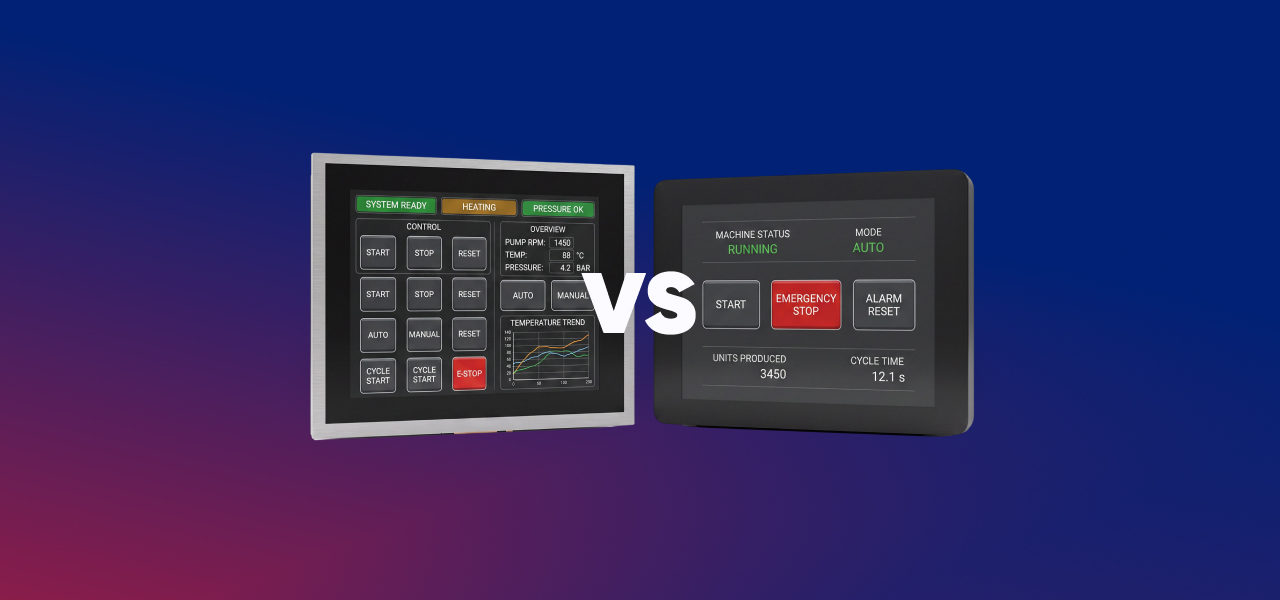
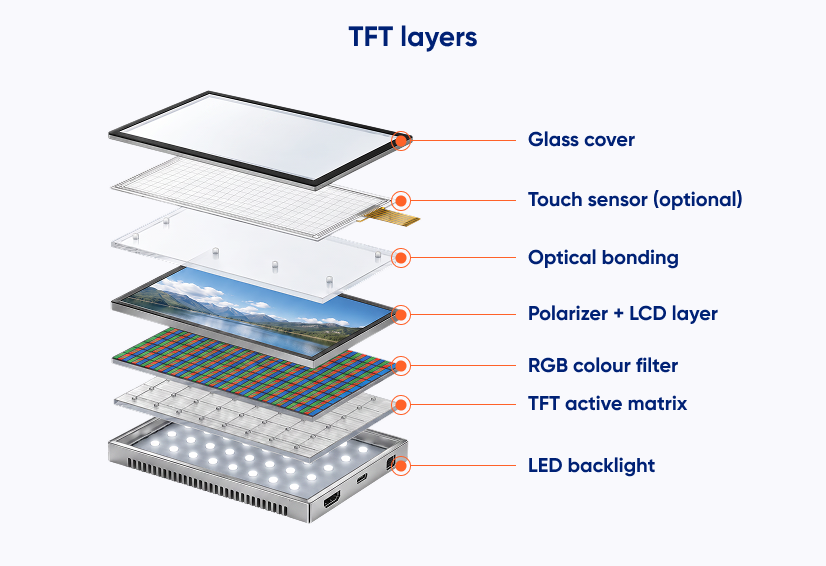
LCD, TFT and LED are often treated as competing display types, although they describe different parts of the same module. We explain how LCD, TFT and LED relate to one another, compare the main panel technologies to help you choose the right option for your project.
Quick answer
TFT is the active-matrix technology used to control an LCD, and LED usually describes the backlight rather than a separate display matrix.
| LCD | TFT | LED-backlight |
| Uses liquid crystals to modulate light. | Uses thin-film transistors to control LCD subpixels. | Uses LEDs to illuminate the LCD from behind. |
| Covers segment, character, passive-matrix and TFT LCDs. | Supports colour graphics and faster image updates. | Used in most current TFT LCD modules. |
Most modern embedded colour displays combine all three: an LCD panel, TFT active-matrix control and an LED backlight.
LCD vs TFT – side-by-side comparison
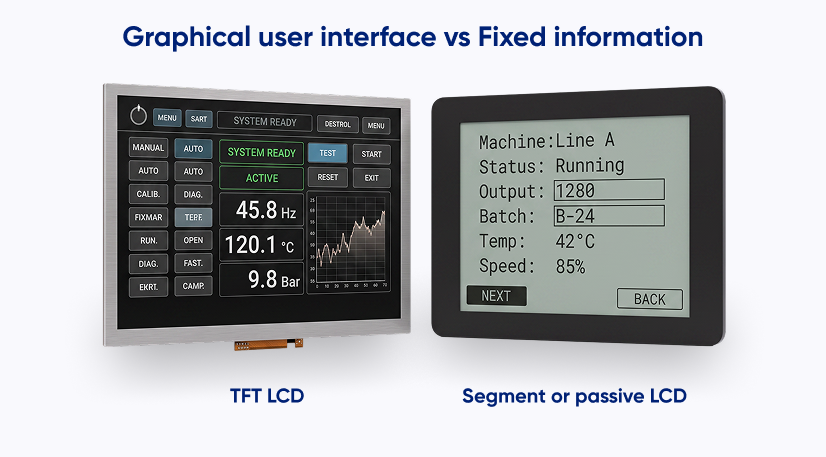
Here, standard LCD means a segment, character or passive-matrix display. TFT means an active-matrix colour LCD.
| Parameter | Standard LCD | TFT LCD |
| Pixel control | Segments or matrix lines are driven together. | Each subpixel is controlled through a thin-film transistor. |
| Image quality | Suitable for digits, icons and simple monochrome graphics. | Suitable for colour GUI, detailed data and animation. |
| Refresh and ghosting | Slower response; ghosting becomes more visible in larger matrices and at low temperatures. | Faster updates and more stable control of individual subpixels. |
| Viewing angles | Depend on LCD mode, polarizers and construction. | Depend on panel type; IPS performs better off-axis than TN. |
| Cost | Lower for simple interfaces. | Higher because the panel and drive electronics are more complex. |
| Typical use | Meters, status panels and battery-powered devices. | HMI panels, medical devices, kiosks and control systems. |
A standard LCD still makes sense for fixed values, symbols and low-power operation. TFT LCD is usually selected when the interface must show colour, frequent changes or detailed graphics.
LED vs TFT – why this comparison is misleading
TFT refers to active-matrix pixel control inside the LCD panel. LEDs sit in the backlight, so an LED-backlit TFT uses both.
| Parameter | CCFL-backlit TFT | LED-backlit TFT |
| Brightness | Limited by tube size and light distribution. | Easier to scale for high-brightness modules. |
| Energy efficiency | Higher power use and inverter losses. | Lower power use for the same screen size. |
| Thickness | Requires more depth. | Supports thinner backlight assemblies. |
| Contrast | Determined mainly by the LCD panel. | Also determined mainly by the LCD panel; LED control can support dimming. |
| Lifetime | Shorter and more sensitive to ageing. | Longer under normal operating conditions. |
CCFL matters mainly in legacy equipment. New embedded TFT LCD displays normally use LED backlights.
TFT vs IPS vs OLED – where TFT fits on the display spectrum
Product catalogues often use “TFT” for basic TN panels. IPS still uses TFT control but changes the liquid-crystal alignment; OLED removes the LCD layer and backlight.
| Parameter | TFT LCD (TN) | IPS TFT LCD | OLED |
| Viewing angles | Narrower; colour shifts off-axis. | Wider; lower colour and contrast shift. | Wide. |
| Contrast | Moderate. | Moderate to high. | Very high; black pixels can switch off. |
| Power use | Set mainly by backlight level. | Set mainly by backlight level. | Depends strongly on image content. |
| Cost | Lowest. | Higher than TN. | Usually highest. |
| Lifetime | Predictable for static GUI and long operating hours. | Predictable for static GUI and long operating hours. | Depends on brightness, temperature and displayed content. |
| Best use case | Cost-sensitive interfaces viewed mostly from the front. | Industrial, medical and control HMIs. | Dark interfaces, fast response and deep black levels |
Industrial HMIs commonly use IPS TFT LCD because the screen may be viewed from several positions.
OLED is considered when black level and response time are more important than aging behaviour and content-dependent power.
For interfaces with static menus or status bars, we recommend dimming, a screen saver or slight image shifting. OLED can develop permanent burn-in, while TFT LCD may show temporary image retention after long exposure to the same content.
Riverdi TFT vs standard/generic TFT Displays
All Riverdi LCD displays use a TFT active matrix, primarily with IPS panels. The standard range covers 1.54″ to 15.6″, resolutions from 240×240 to 1920×1080 px and brightness from 500 to 1400 cd/m², depending on the module.
| Selection factor | Typical generic TFT display | Riverdi TFT LCD display |
| Matrix | Model-dependent; low-cost modules often use TN. | TFT active matrix, primarily IPS. |
| Brightness | Usually one catalogue option. | 500 to 1400 cd/m² across the portfolio. |
| Touchscreen | None or a separate touch component. | Touch and non-touch variants, with PCAP options by series. |
| Sunlight readability | Depends on panel, cover glass and bonding. | High-brightness IPS, optical bonding and cover glass options. |
| Operating temperature | Commercial or model-dependent range. | Standard modules operate from -20°C to +70°C. |
| Regulatory compliance | Supplier- and model-dependent. | RoHS 3 and REACH compliant. |
Riverdi can integrate the LCD, touch sensor, cover glass and in-house optical bonding within a single front-stack project. Our customized solutions cover brightness, interface, touch tuning, cover glass, bonding, mechanics and housing when the catalogue module does not match the design.
Standard modules are available without MOQ through DigiKey, Mouser, RS and TME. Component availability is planned for 10+ years, which reduces the risk of a forced redesign during the product lifecycle.
Which is better? – Decision matrix
| Project type | Recommended technology |
| Budget equipment | Segment or character LCD for fixed data; TN TFT LCD when a colour GUI is required. |
| Consumer device | IPS TFT LCD for general use; OLED when black level or module thickness has priority. |
| Industrial equipment | High-brightness IPS TFT LCD with touch and bonding selected for the environment. |
| Medical device | IPS TFT LCD with stable off-axis image, front integration and long component availability. |
Choose the display based on the required content, viewing conditions, power budget, operating time and product lifecycle.
Quick checklist before you choose
- Define the available budget for the display, controller, memory, touch and bonding.
- Check the operating temperature and expected ambient light.
- Decide whether the interface needs PCAP, resistive touch or no touch.
- Match screen size and resolution to the GUI and viewing distance.
- Check sealing, dust and moisture ingress, and reflections from any air gap.
- Confirm prototype quantity, production volume and required availability period.
FAQ
Is TFT always better than standard LCD?
No. TFT is the right choice for colour graphics and changing data. Segment and character LCDs still make sense for fixed information and low-power products.
Does LED backlighting make a display better than TFT?
LED and TFT affect different parts of the module. LED can reduce power and thickness, but image quality still depends on the LCD panel.
Is IPS the same as TFT?
IPS is a type of TFT LCD. It changes how the liquid crystals are arranged and improves off-axis image stability.
Are all Riverdi displays TFT?
All Riverdi LCD displays use TFT active-matrix technology, primarily with IPS panels. Touch, backlight and module configuration are separate design choices.
DISCOVER OUR
Whitepaper
Achieve the perfect user-display interaction with the right Touch Sensor IC. Ever faced issues with phantom touch events or certification? Boost your R&D like a pro with our Whitepaper!
Go to our product catalog and see how you can save by quality, not on quality.