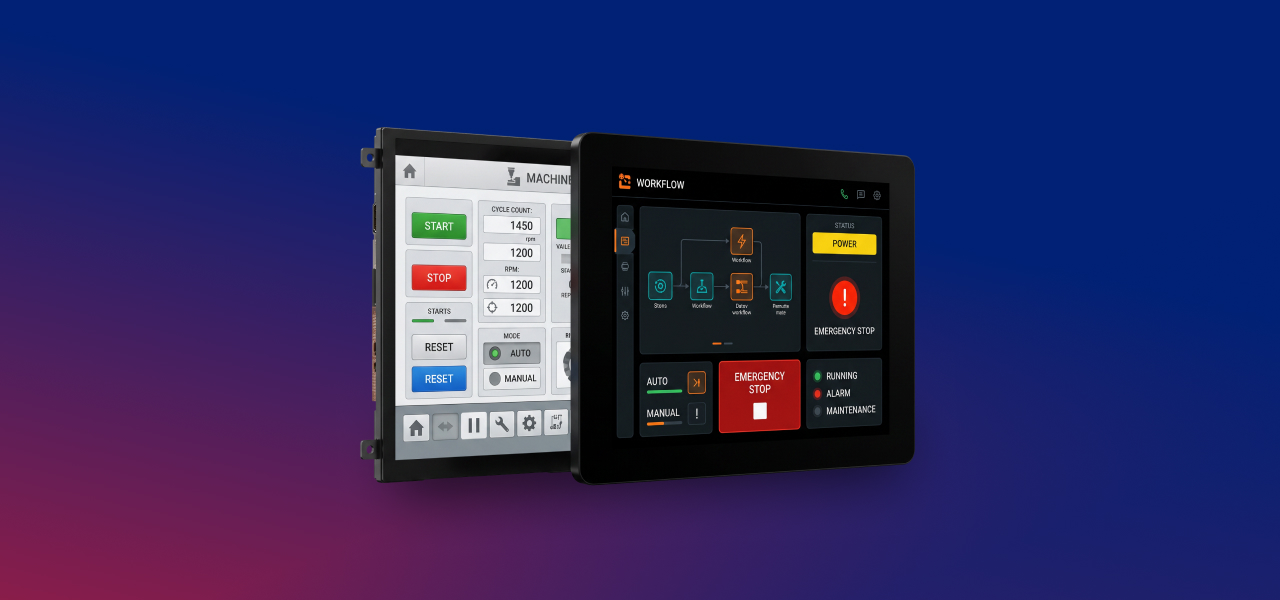
A panel-level comparison is just the beginning for an industrial design. TFT LCD and AMOLED must be evaluated as complete modules, including the touch layer, cover glass, thermal conditions, UI content and expected production lifetime.
Quick answer and comparison table
AMOLED suits motion-heavy interfaces, so it is most often used in smartphones, wearables and selected handheld or multimedia devices rather than always-on industrial HMIs. TFT LCD displays are usually easier to qualify for static industrial UI, high full-screen luminance and long production cycles.
| Criterion | TFT LCD | AMOLED |
| Image | Black level is limited by backlight leakage. | Lower black luminance, faster response and often a wider color gamut. |
| Sunlight | Full-screen luminance depends mainly on backlight current, stack transmission and temperature. | Verify sustained luminance at the required APL and temperature. |
| Lifetime | No OLED-type differential emitter aging. Temporary image persistence is possible. | Static content can cause permanent luminance and color non-uniformity. |
| Power | Backlight load is mostly independent of image content. | Power rises with luminance and bright image area. |
| Cost | Wider industrial availability and more replacement options. | Higher qualification and sourcing risk in single-source formats. |
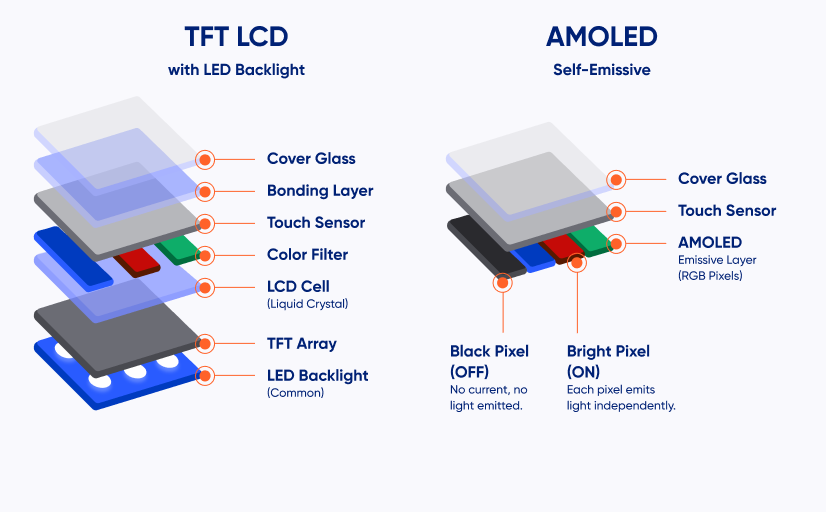
Image quality & brightness
At black level, OLED emitter current approaches zero, so the subpixel emits no intentional light. What remains visible depends mainly on reflections from the front stack. AMOLED can also cover a wider color gamut, although accuracy still depends on calibration, drive mode and luminance.
A conventional TFT LCD uses a common backlight. Without local dimming, full-screen luminance stays largely unchanged when the UI switches from a small bright element to a full-white alarm screen.
AMOLED is comparable to an array of individually controlled candles, while TFT LCD resembles a ceiling lamp shining through adjustable shutters.
Brightness values are not directly comparable without test conditions. For AMOLED, check sustained luminance at the required average picture level (APL), panel temperature and drive mode. A peak value measured on a small white area does not describe a full-white service screen. For TFT LCD, verify luminance at the maximum ambient temperature and at the outer cover-glass surface.
Touch, bonding, cover glass and coatings affect both transmission and reflection. Outdoor qualification should therefore use the ambient contrast ratio of the assembled device, measured at the specified illuminance and viewing geometry.
For example, a 7-inch HMI requiring 800 cd/m² at the cover glass, operation at 60°C and a full-white alarm screen needs backlight derating and thermal checks. An AMOLED candidate also requires 100% APL luminance data and a burn-in model for fixed UI areas.
Durability, power & cost
AMOLED lifetime data is useful only with the stated L50 or L70 criterion, initial luminance, temperature and duty cycle. Static-content exposure must be assessed separately. Pixel shifting, dimming and blanking can reduce visible burn-in. They do not stop differential aging. TFT LCD may show temporary image persistence after prolonged static content, but this is not OLED-type burn-in.
Power comparison requires the same front-surface luminance and defined test images. Record APL, temperature, supply conditions and measurement time.
For TFT LCD, include the LED driver, backlight current, dimming profile and thermal derating. For AMOLED, test the real GUI. A dark standby screen and a full-white service screen produce different loads.
Cost includes the complete module and qualification. Single-source formats become expensive when EOL forces hardware or software redesign. Panel-level repair is uncommon in both technologies – service cost depends mainly on module replacement and touch or optical-stack recalibration.
Which is better for you? Decision matrix
| Application or design condition | Parameter to verify | Usual choice |
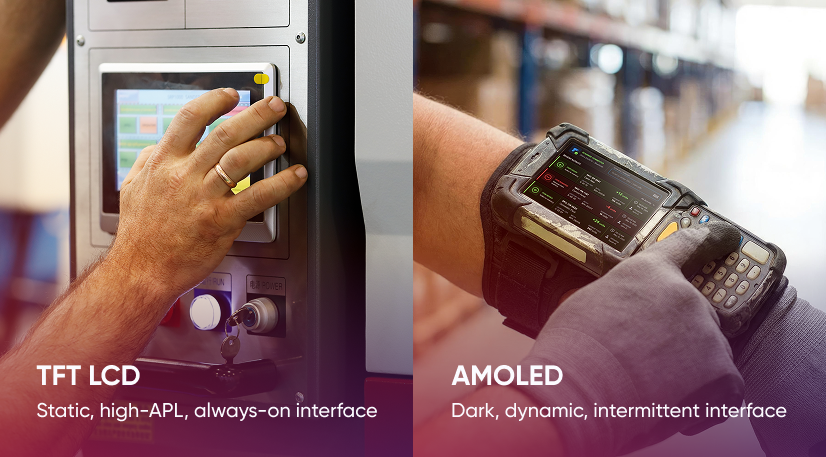
| Fixed status bars or machine diagrams | Static-content duty cycle and required lifetime | TFT LCD |
| Reading, documentation or a predominantly white UI | Full-screen luminance, power and temperature at high APL | TFT LCD |
| Outdoor terminal or EV charger | Finished-stack reflectance and sustained luminance at maximum temperature | Usually TFT LCD |
| Budget-sensitive embedded product | Module cost, qualification cost and replacement availability | Usually TFT LCD |
| Mostly dark, battery-powered UI | Power measured with representative content | AMOLED may fit better |
| Gaming or multimedia | Pixel response, motion artifacts and black luminance | Usually AMOLED |
| Long production cycle | Supplier roadmap, PCN/EOL policy, second source and redesign risk | Usually TFT LCD |
Riverdi’s standard catalog contains industrial TFT LCD modules planned around 10+ years of component availability. Standard modules are available without MOQ through DigiKey, Mouser, RS Components and TME.
AMOLED is not a standard catalog product; it is evaluated only as a customized solution.
FAQ
Which technology is easier to source for a long-life industrial product?
TFT LCD is easier to source because industrial panel families usually have longer product roadmaps and more replacement options. AMOLED formats are more often tied to shorter consumer-market cycles and higher EOL risk.
Does optical bonding change the choice between TFT LCD and AMOLED?
Not really. It can improve front-stack contrast in both technologies, but it does not remove AMOLED burn-in or ABL behavior.
Can AMOLED be used in a static industrial HMI?
Only with burn-in mitigation built into the UI and firmware. For always-on screens IPS TFT LCD is the safer choice.
Does Riverdi offer AMOLED displays?
AMOLED is available as a customized solution, not as a standard catalog product.
DISCOVER OUR
Whitepaper
Achieve the perfect user-display interaction with the right Touch Sensor IC. Ever faced issues with phantom touch events or certification? Boost your R&D like a pro with our Whitepaper!
Go to our product catalog and see how you can save by quality, not on quality.